


Iona, Saint Columba and the Christian Story of Scotland

Updated: 3 days ago
Iona: an island in a wider Celtic Christian story
Iona is a small island with a deep Christian memory. Its story belongs not only to Scotland, but to the sea roads between Ireland, the Hebrides, monastic communities, pilgrims, makers and the wider Celtic diaspora. Iona is often spoken of as one of Scotland’s most sacred Christian places. That is true, but it is not the whole story.

Iona also belongs to the sea.
Its Christian memory flows across the water between Ireland and Scotland, through island monasteries, saints, pilgrims, carved crosses, manuscripts, handmade objects, and the long journeys of Celtic people who carried faith, grief, memory and hope far beyond these shores.
For Paisley Honey, Iona is not simply a Scottish theme. It sits within a much older Atlantic Christian world: Ireland, Scotland, Rathlin, Kells, the Hebrides, the west coast, the famine roads, America, Canada, and all the places where people carried prayer with them when they had to leave home.
That is part of why Iona still matters. It is not just a destination. It is a crossing point.
Saint Columba and the sea road between Ireland and Scotland
Saint Columba, also known as Colum Cille, came from Ireland to Iona in AD 563 with a small group of companions. From that island monastery, Christian life, learning and mission spread across parts of Scotland and beyond.
But it is important not to imagine Ireland and Scotland as two sealed-off worlds. In Columba’s time, the sea was not only a barrier. It was a road.

People crossed it with boats, stories, prayers, kinship, language, craft and faith. Islands such as Iona and Rathlin were not remote in the way we might imagine today. They were part of a living network of sea routes, holy places, monastic communities and shared culture.
That is the world Iona belongs to: not a neat modern map, but a moving, salt-water world of crossings.
Faith carried by hand
The Christian story of Iona was not built first from comfort or power. It was shaped by people who crossed water, settled in hard places, prayed in community, worked with their hands, copied manuscripts, carved stone, tended land, welcomed strangers and repeated the daily practices of faith.
That matters for anyone drawn to handmade devotional objects today.
A rosary, prayer beads, a Celtic cross or a leather prayer pouch is not simply decoration. At its best, it is something made to be held, carried and prayed with. It belongs to the same deep instinct that shaped carved crosses, illuminated manuscripts, wooden benches, metalwork, monastic tools and simple objects of daily devotion.
Faith becomes tangible.
It gathers in the hand.

It is carried in a pocket, around the wrist, in a bag, across the sea, or into a new life far from home.
Kells, craft and the memory of making
The Book of Kells is one of the great treasures of this wider Celtic Christian world. Its pattern, line, symbol and sacred imagination continue to inspire artists, carvers, metalworkers and makers.
For us, that connection is not abstract. I grew up around it. My father is an artist whose work has long drawn from Kells-inspired forms, especially in wood and metal. Some of my earliest memories are of sitting at his bench as a young child, with woodchips and dust everywhere, watching ancient patterns become something physical under the hand.
That kind of making leaves a mark.
It teaches that Christian art is not only something in museums or manuscripts. It can live in wood, metal, leather, beads, tools, dust, repetition and care. It can pass quietly from one generation to another.
Paisley Honey grows from that same soil: Irish and Scottish, handmade and devotional, shaped by old sites, island journeys, bees, craft, prayer and place.
Iona, Rathlin and the island imagination
There are places where history does not feel distant. Rathlin is one of them. Iona is another.
Both belong to that island imagination of the western sea: small communities, weather, crossings, birds, ruins, saints, hardship, prayer and memory. These are places where Christianity was not grand or polished at first. It was lived close to the elements.
On Rathlin, at the end of my father’s land, there is an old monastic beehive sweat lodge. Passing a place like that is a reminder that ancient faith was bodily as well as spiritual. It involved heat, stone, work, healing, discipline, land and weather.

Beekeeping also belongs naturally to this world. Bees carry their own monastic rhythm: labour, order, sweetness, danger, patience and return. There is something deeply fitting about devotional objects made by a beekeeper, especially in a tradition where monks, islands, gardens, hives and handmade work have always sat close together.
Iona and the story of leaving home
The Celtic Christian story is not only a story of saints. It is also a story of ordinary people leaving home.
From the west of Ireland and the Scottish islands, countless people crossed water because they had to: for survival, work, exile, hunger, grief or hope. During the Great Famine, ships left the western shores of Ireland carrying people towards America and Canada. Later generations carried names, prayers, medals, rosaries, stories and fragments of home into new countries.
That is one reason devotional objects matter.
A rosary is small enough to carry when almost everything else must be left behind. A cross can become a point of memory. Prayer beads can mark a path through fear, grief, gratitude or beginning again.
Iona speaks into that wider story because it is also a place of departure and return. Columba crossed from Ireland to Iona. Pilgrims cross to Iona still. People continue to seek places and objects that help them remember who they are, where they come from, and what they are carrying.
Not Scotland or Ireland, but a shared Christian inheritance
It is tempting to make these stories too tidy: Irish here, Scottish there, Celtic somewhere else again.
But the older story is more fluid than that.
Iona’s Christian heritage is Scottish and Irish. It is island and mainland. It is monastic and domestic. It belongs to saints and to ordinary families. It belongs to carved stones and kitchen tables, ancient sites and workshop benches, abbeys and hives, pilgrims and emigrants.
For Paisley Honey, that shared inheritance is important. We make devotional objects in Scotland, but the story behind them flows across the Irish Sea and out into the wider Atlantic world.
That is why an Iona-inspired rosary or prayer pouch should not feel like a souvenir. It should feel like something carried from a deeper place.
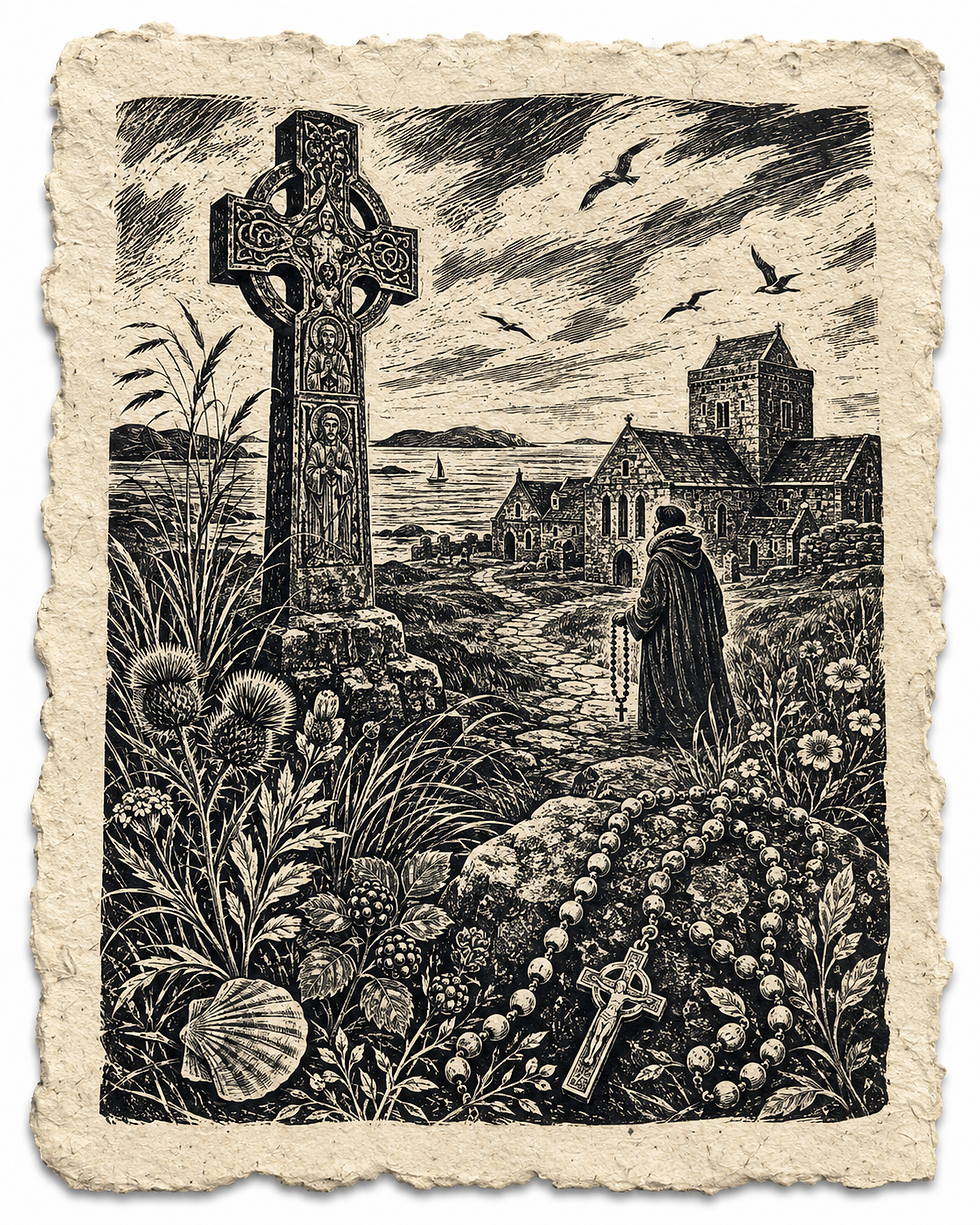
Christian gifts inspired by Iona
A Christian gift inspired by Iona should feel rooted, quiet and sincere.
It does not need to be loud or overly polished. It should feel like something with meaning: a devotional companion, a prayer tool, a reminder of pilgrimage, or a small piece of the Celtic Christian story held in the hand.
Paisley Honey’s Iona-inspired devotional pieces are handmade in Scotland and shaped by this wider world of island faith, Celtic Christian art, family craft, beekeeping, migration, prayer and return. They are not official Iona products and are not connected with any Iona organisation. They are made with respect for the island’s Christian heritage and for the many people who still find meaning in its story.
Explore our handmade Iona collection for Saint Columba Catholic rosaries, jade Anglican prayer beads and Saint Martin’s Cross necklaces. To see how the island’s imagery shaped the metalwork, read the story and symbolism behind our Iona rosary.
A rosary can become a small pocket chapel. A prayer pouch can become a way of carrying faith safely through the day. A handmade devotional gift can say something gentle but lasting: I am praying for you. Begin again. You are not alone.
Carrying the story forward
Iona’s story began long before us, and it will continue long after us.
That is part of its strength.
The island reminds us that faith is carried across generations in many ways: through saints and scripture, through abbeys and ruins, through boats and crossings, through famine roads and new countries, through family workshops, through bees and gardens, through prayer and silence, through things made carefully by hand.
To hold a rosary or prayer beads inspired by Iona is not to possess the island. It is to remember something of what the island points towards: prayer, courage, crossing, return, and the presence of God in small and weathered places.
For anyone looking for a Christian gift from Scotland, or a handmade rosary with a deeper sense of place, Iona offers more than design inspiration.
It offers a story still worth carrying.
Questions people often ask about Iona, Saint Columba and Celtic Christian gifts
Why is Iona important in Christianity?
Iona is important because Saint Columba founded a monastery there in the sixth century. It became one of the most influential early Christian centres in Scotland and remains a place of pilgrimage, prayer and Christian memory.
Is Iona Irish or Scottish in Christian history?
Iona is part of both Irish and Scottish Christian history. Saint Columba came from Ireland to Iona, and the island became central to the spread of Christianity in Scotland. Its story belongs to the wider Celtic Christian world of sea routes, islands, monasteries and shared faith.
What is the connection between Iona and Saint Columba?
Saint Columba, also known as Colum Cille, came to Iona from Ireland in AD 563. The monastic community he founded there became one of the most important Christian centres in the early medieval Atlantic world.
What is a meaningful Iona-inspired Christian gift?
A meaningful Iona-inspired Christian gift should feel rooted in prayer, pilgrimage and place. Handmade rosaries, Anglican prayer beads, Celtic crosses and leather prayer pouches all connect naturally with Iona’s themes of faith carried by hand.
Are Paisley Honey Iona-inspired pieces official Iona products?
No. Paisley Honey’s Iona-inspired pieces are handmade in Scotland and inspired by Iona’s Christian heritage, but they are not official Iona products and are not affiliated with any Iona organisation.
Why do rosaries and prayer beads suit this story?
Rosaries and prayer beads are small, tactile and portable. They can be carried across journeys, held during grief or gratitude, and used when prayer needs somewhere to begin. That makes them especially fitting for a story shaped by pilgrimage, crossing, memory and return.

Comments