


Why Is Saint Dymphna the Patron Saint of Mental Health?
- Fiach OBroin-Molloy

- Jul 5
- 6 min read
Saint Dymphna is known in Catholic tradition as the patron saint of mental health, anxiety, nervous disorders and those carrying emotional distress. Her story is one of courage, trauma, faith and refuge — and although parts of it come to us through legend, her legacy has become deeply meaningful for people who pray through fear, depression, grief or mental strain.

She is also an Irish saint. That matters.
Saint Dymphna belongs to that wide, beautiful world of early Celtic Christianity: saints, pilgrims, exiles, holy wells, sea-crossings and places of refuge. Like many Irish saints, her story does not stay neatly within one island. It moves across water. It carries the feeling of someone leaving home in search of safety, and becoming a sign of hope in another land.
Who was Saint Dymphna?
The traditional story says that Dymphna was born in Ireland in the 7th century, the daughter of a pagan Irish king and a Christian mother. She was raised in the Christian faith and, while still young, dedicated herself to Christ.
After her mother died, Dymphna’s father was overwhelmed by grief and became dangerously unstable. In the traditional account, he developed a distorted attachment to his daughter and wished to marry her. Dymphna refused. With the help of her priest and confessor, Saint Gerebernus, she fled Ireland and crossed the sea to the continent.
Eventually, she settled in Geel, in what is now Belgium. There, according to tradition, she lived quietly, served others and cared for people in need. Her father later found her. When she refused to return with him, she was martyred.
It is a painful story, and it should be told carefully. Saint Dymphna is not remembered because suffering is beautiful. She is remembered because she stood against fear, coercion and violence with courage and faith.
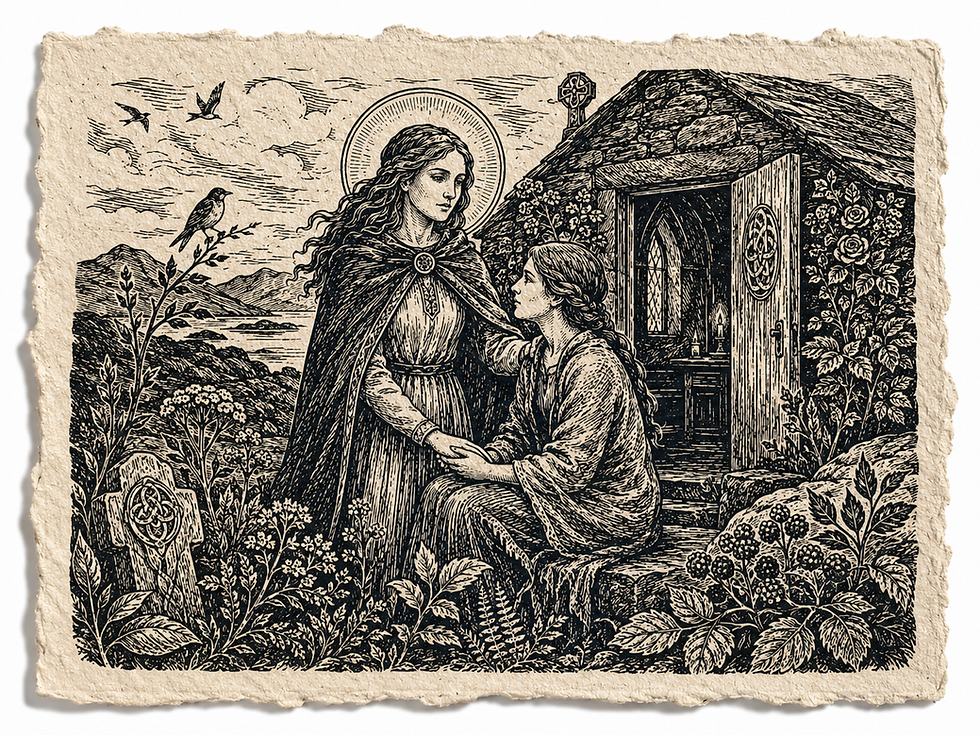
Why is Saint Dymphna patron saint of mental health?
Saint Dymphna became associated with mental health for several reasons.
First, her own story is marked by trauma, fear and the search for safety. Many people who feel overwhelmed, anxious or emotionally wounded find something recognisable in her life. She is not a distant saint of perfect calm. She is a saint who knew danger, grief and vulnerability.
Second, the traditional story describes her father as deeply disturbed after the death of Dymphna’s mother. Over time, people began to ask Saint Dymphna’s intercession for those suffering from mental illness, nervous disorders, anxiety, emotional pain and distress within families.
Third, and perhaps most importantly, her shrine at Geel became connected with an extraordinary tradition of care. People struggling with mental illness came to Geel seeking healing and intercession. Over the centuries, the local community became known for welcoming people with mental health difficulties into ordinary homes and ordinary daily life.
That is part of what makes Saint Dymphna’s patronage so powerful. Her legacy is not only about private prayer. It is also about compassion, hospitality and the dignity of people who suffer.
The Irish and Celtic thread in her story
Saint Dymphna’s Irishness is not a decorative detail. It gives her story part of its shape. Early Irish Christianity was full of movement: monks, missionaries, pilgrims and exiles crossing the sea with faith as their compass. Dymphna’s story has that same Atlantic feeling — a young Irish woman leaving home, crossing water, and finding refuge in a foreign place.
Her name is also sometimes seen in Irish forms and traditions connected with names such as Dympna, Damhnait or Davnet, though the historical links can be complex and are not always treated in the same way by scholars and local traditions. That very complexity is part of the Celtic Christian world: saints remembered through place, prayer, story, local wells, feast days and the devotion of ordinary people.
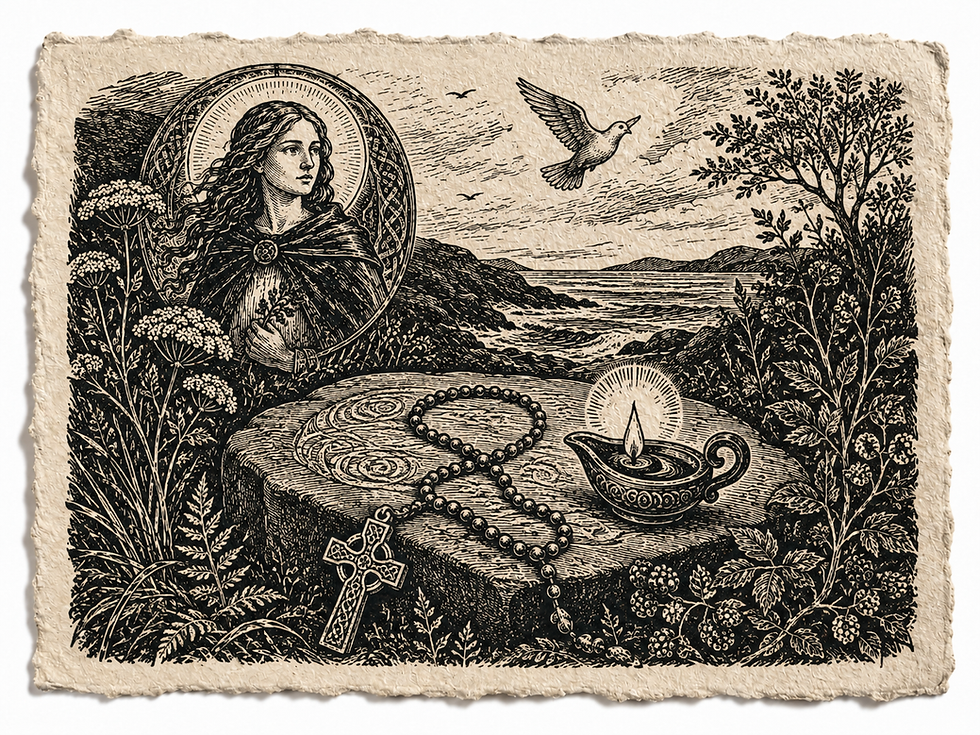
For Irish and Irish-diaspora Catholics, Saint Dymphna can feel especially close. She is not only “the patron saint of mental health” in a general sense. She is an Irish daughter of faith whose story travelled far beyond Ireland and became a source of comfort to people across the world.
A saint for hidden suffering
Mental suffering is often hidden. A person may look composed while carrying anxiety, exhaustion, trauma, depression or fear. Families may carry worry for someone they love. Friends may not know what to say. Faith can feel difficult when the mind is tired
.
Saint Dymphna’s story speaks gently into that hidden place.
She reminds us that the person who suffers is not a problem to be hidden away. They are loved by God. They deserve care, patience, tenderness and practical support. Prayer is not a replacement for medical help, therapy, crisis care or the support of trusted people. But prayer can sit beside those things. It can become one small way of holding on.
For some, praying with a rosary or a small set of prayer beads can help give shape to anxious moments. The beads do not solve the pain. They simply give the hands something steady to hold, and the heart a way to keep returning to God.
How do Catholics pray with Saint Dymphna?
Catholics ask Saint Dymphna to pray for those who are struggling with mental illness, anxiety, fear, grief, trauma, emotional distress or nervous disorders.
A simple prayer might be:
Saint Dymphna, pray for all who are anxious, afraid or overwhelmed.Pray for those who live with mental illness, for those who care for them, and for those who feel alone in their suffering. May Christ bring peace, courage, healing and help. Amen.
Some people pray a novena to Saint Dymphna. Others light a candle, carry a prayer card, use a rosary, or simply say her name quietly when they do not have many words.
The important thing is not the length of the prayer. It is the turning toward God with honesty.
Saint Dymphna as a gift of hope
A devotional gift connected with Saint Dymphna should always be offered with sensitivity. Mental health is not a marketing theme. It is a deeply human reality.
But there are moments when a small devotional gift can say something words struggle to say: You are loved. You are not forgotten.I am praying for you. You do not have to carry this alone. A rosary, prayer beads, a saint medal, a small leather pouch or a prayer card can become a quiet sign of accompaniment. Not a cure. Not a promise that everything will instantly feel better. Simply a faithful object held in difficult moments.
That is very much in the spirit of Saint Dymphna: refuge, gentleness, courage and care.
Why Saint Dymphna still matters
Saint Dymphna matters because mental suffering is not rare, and it is not shameful. Her story reminds Christians that compassion is not optional. The legacy of Geel shows something deeply practical: people in distress need prayer, yes, but also welcome, patience, community and ordinary human kindness.
For those with Irish roots, her story also carries a familiar spiritual pattern: the saint who crosses the sea, the exile who becomes a blessing, the fragile life that becomes a place of shelter for others.
Saint Dymphna is a patron for people who are afraid, but still trying. For people who pray through panic. For families who are worried. For those whose suffering is not visible. For those who need a saint who understands that peace is sometimes something we receive one breath, one prayer, one bead at a time.

Questions people often ask about Saint Dymphna
Who is Saint Dymphna?
Saint Dymphna is a traditional Irish saint and martyr, usually said to have lived in the 7th century. She is especially known today as the patron saint of people living with mental illness, anxiety, nervous disorders and emotional distress.
Why is Saint Dymphna the patron saint of mental health?
Saint Dymphna is connected with mental health because of her own traumatic story, the mental disturbance described in the traditional account of her father, and the long history of care associated with her shrine at Geel in Belgium. Over time, Catholics began asking her intercession for those suffering in mind, heart and spirit.
Is Saint Dymphna Irish?
Yes. In the traditional account, Saint Dymphna was born in Ireland. Her story later moves to Geel in Belgium, where she was martyred and where devotion to her became especially strong. This gives her story a powerful Irish and European connection.
What is Saint Dymphna’s feast day?
Saint Dymphna is traditionally associated with 15 May, though some modern calendars also refer to 30 May in connection with her martyrdom. Many Catholics continue to honour her in May, a month that is also widely associated with mental health awareness.
Can I pray to Saint Dymphna for anxiety?
Yes. Catholics often ask Saint Dymphna to pray for them during anxiety, panic, depression, emotional distress or mental illness. Prayer should not replace medical, therapeutic or crisis support, but it can be a meaningful part of how someone seeks comfort, courage and peace.
What is a thoughtful Saint Dymphna gift?
A thoughtful Saint Dymphna gift might be a rosary, prayer beads, a saint medal, a prayer card or a small pouch for devotional items. The best gifts are gentle and respectful, offered as a sign of prayer and companionship rather than as a cure or easy answer.
Why does Saint Dymphna matter to Irish Catholics and the Irish diaspora?
Saint Dymphna’s story begins in Ireland and travels across the sea, which gives it a strong Irish and Celtic Christian feeling. For Irish Catholics and the Irish diaspora, she can feel like a saint of exile, courage, hidden suffering and hope carried far from home.

Comments