


An A to Z of Celtic Saints

Updated: Jul 19
A gentle guide to holy men and women from Ireland, Scotland, Wales, Cornwall and Brittany
The Celtic Christian world was never tidy. It was made of islands, shorelines, monasteries, pilgrim routes, mountain paths, holy wells, beehive cells, stone crosses and small communities of prayer. Its saints were not all “Celtic” in the same neat modern sense.

Some were Irish, some Scottish, some Welsh, some Cornish, some Breton, and some moved between these places by boat, exile, mission or pilgrimage.
Many of their stories come to us through a mixture of history, hagiography, local devotion and legend. That does not make them less valuable. In fact, it is often the legends that show us what people remembered: courage, hospitality, healing, learning, prayer, repentance, protection, and the grace of beginning again.
This is not a complete dictionary of Celtic saints. It is a devotional A to Z: a doorway into some of the saints, symbols and places that shaped the Christian imagination of the Celtic world.
A is for Saint Aidan of Lindisfarne
Saint Aidan was an Irish monk formed in the tradition of Iona before he became bishop of Lindisfarne, the Holy Island off the coast of Northumbria. He is remembered for gentleness, patience and missionary courage.

Aidan’s life reminds us that Christian witness does not always begin with noise or argument. Sometimes it begins with walking from village to village, listening well, teaching simply, and living close to the people one hopes to serve.
B is for Saint Brigid of Kildare
Saint Brigid is one of Ireland’s great patron saints, loved for her associations with hospitality, healing, generosity and the famous woven Brigid’s cross. Her feast day, 1 February, sits beautifully at the turning of winter towards spring.
Brigid’s story carries the warmth of the hearth. She is a saint of milk and bread, fire and welcome, practical mercy and open doors. For many people, devotion to Brigid feels domestic in the best sense: holiness made visible in daily care.
C is for Saint Columba, or Colmcille
Saint Columba, also known as Colmcille, is one of the great saints of both Ireland and Scotland. Born in Ireland, he travelled to Iona, where his monastery became one of the most important centres of Christian life in the early medieval north Atlantic world.
Columba’s story carries the ache of exile and the grace of a new beginning. For those drawn to Iona, he remains a saint of prayer, poetry, repentance, learning and mission across the sea.

D is for Saint David of Wales
Saint David, or Dewi Sant, is the patron saint of Wales. He is often remembered through the phrase “do the little things,” a simple line that has travelled far beyond Wales because it speaks to something deeply Christian.
David’s holiness is not grand or theatrical. It is the holiness of faithfulness: small acts done well, prayer kept, community served, courage practised quietly. His story is a reminder that little things are not necessarily small in the eyes of God.
E is for Saint Enda of Aran
Saint Enda is strongly associated with the Aran Islands and the growth of Irish monasticism. The western islands became places of prayer, training and spiritual discipline, drawing others who would later become important saints and founders themselves.
Enda represents the desert instinct in Celtic Christianity: the desire to go somewhere sparse and wind-scoured, not to escape the world in bitterness, but to meet God with fewer distractions.
F is for Saint Finbarr of Cork
Saint Finbarr is remembered as a founder and patron connected with Cork. Like many early saints, he is associated with a monastic foundation that became a place of learning, prayer and community.
His story reminds us that monasteries were not only places of retreat. They were also schools, workshops, libraries, farms and centres of hospitality. In the Celtic Christian world, learning and prayer often grew from the same root.

G is for Saint Gobnait
Saint Gobnait of Ballyvourney is especially dear to anyone who loves bees. She is traditionally associated with healing, protection and beekeeping, and her feast day is kept on 11 February.
For Paisley Honey, she feels like a sister-saint in the background of the work: a reminder that bees have long carried spiritual meaning in Irish memory. Honey, healing, labour, community and sweetness all gather around her story.
H is for Saint Hilda of Whitby
Saint Hilda of Whitby was not “Celtic” in the narrowest ethnic sense, but she belongs in this world because her life stands at the meeting point of Celtic and Anglo-Saxon Christianity. As abbess of Whitby, she led one of the most important religious communities in early medieval Britain.
Hilda is a saint of wisdom, leadership and holy hospitality. Kings and ordinary people sought her counsel. Her life reminds us that Christian authority, at its best, is not domination but steadiness, clarity and service.
I is for Saint Ita of Killeedy
Saint Ita is one of Ireland’s beloved female saints, sometimes remembered as a foster-mother of saints. She is associated with prayer, teaching and spiritual motherhood.
Ita’s story speaks to those who nurture faith in others quietly: parents, godparents, teachers, grandparents, friends, catechists and all who help another person grow in prayer. Not every saint travels across the sea. Some become holy by making one place a school of love.

J is for Saint Jarlath of Tuam
Saint Jarlath is remembered as an early Irish saint connected with Tuam in County Galway. He belongs to the great landscape of Irish monastic learning, where saints are often remembered as teachers as much as miracle-workers.
His place in the alphabet is a reminder that the Celtic saints were not only the famous few. Behind Patrick, Brigid and Columba stands a great cloud of local saints, each tied to a school, a church, a well, a townland or a community of memory.
K is for Saint Kentigern, also called Mungo
Saint Kentigern, better known in Glasgow as Saint Mungo, is the city’s beloved patron. His symbols are woven into Glasgow’s story: the bird, the tree, the bell and the fish with the ring.
Mungo’s name is often understood as meaning “dear one” or “beloved.” That alone makes him feel close. He is a saint of the west of Scotland, of city and river, of local memory and Christian beginnings.
L is for Saint Laisrén of Devenish
Saint Laisrén, also known as Mo Laisse, is associated with Devenish Island in Lough Erne. Like many Celtic saints, his memory is tied to a particular island landscape, a monastery and a local pattern of devotion.
The island saints matter because they show how geography shaped prayer. Water, crossings, weather and remoteness were not incidental. They formed the imagination. A monastery on an island is a visible sign that prayer often begins by crossing over.

M is for Saint Maelrubha of Applecross
Saint Maelrubha was an Irish saint who became deeply associated with Applecross in the north-west of Scotland. His name survives in place, memory and devotion across parts of the Highlands.
He represents the movement between Ireland and Scotland that shaped so much of the early Christian story here. The sea was not simply a barrier. It was a road. Saints, monks, manuscripts, prayers and devotions crossed it.
N is for Saint Ninian of Whithorn
Saint Ninian is traditionally associated with Whithorn in Galloway and is often remembered as one of the earliest Christian figures connected with Scotland. Historically, he is a shadowy figure, and much about him is debated.
That uncertainty is part of the honesty needed with early saints. Sometimes we do not have neat facts. What we have is a long memory of prayer, pilgrimage and devotion attached to a place. Whithorn still carries that sense of ancient Christian rootedness.
O is for Saint Odran of Iona
Saint Odran, or Oran, is traditionally remembered as a companion of Columba and as the first Christian buried on Iona. His name remains attached to Reilig Odhráin, the ancient burial ground on the island.
Odran’s story is wrapped in legend, but his place in the Iona landscape is powerful. He reminds us that Celtic Christianity was not only about journeying. It was also about burial, memory, ancestors and the hope of resurrection.

P is for Saint Patrick
Saint Patrick is the best-known saint of Ireland, but familiarity can sometimes flatten him. Behind the shamrocks and annual celebration is a remarkable story of captivity, conversion, return and mission.
Patrick’s life speaks to those who have known fear, displacement or a hard beginning. He is not merely a national symbol. He is a saint of courage: a man who returned in love to the land of his suffering.
Q is for Saint Quay, also known as Saint Kea
Q is one of the awkward letters in any A to Z of Celtic saints. One honest way through is Saint Quay, the Breton form associated with Saint Kea, a saint linked with Cornwall and Brittany.
Kea’s story shows how names shift as they cross languages and coastlines. A saint remembered in one place as Ke may become Quay in another. The Celtic Christian map is full of these crossings, where faith travels by boat and changes its accent on arrival.
R is for Saint Ronan
Saint Ronan is remembered in both Irish and Breton tradition, especially through Locronan in Brittany. His name has the beautiful meaning of “little seal,” which gives him an immediate connection with the sea.
Ronan belongs to the world of pilgrim saints and hermits, figures who moved across the western seaways and became rooted in new places. His story feels salt-weathered: prayer, coast, solitude and local devotion.
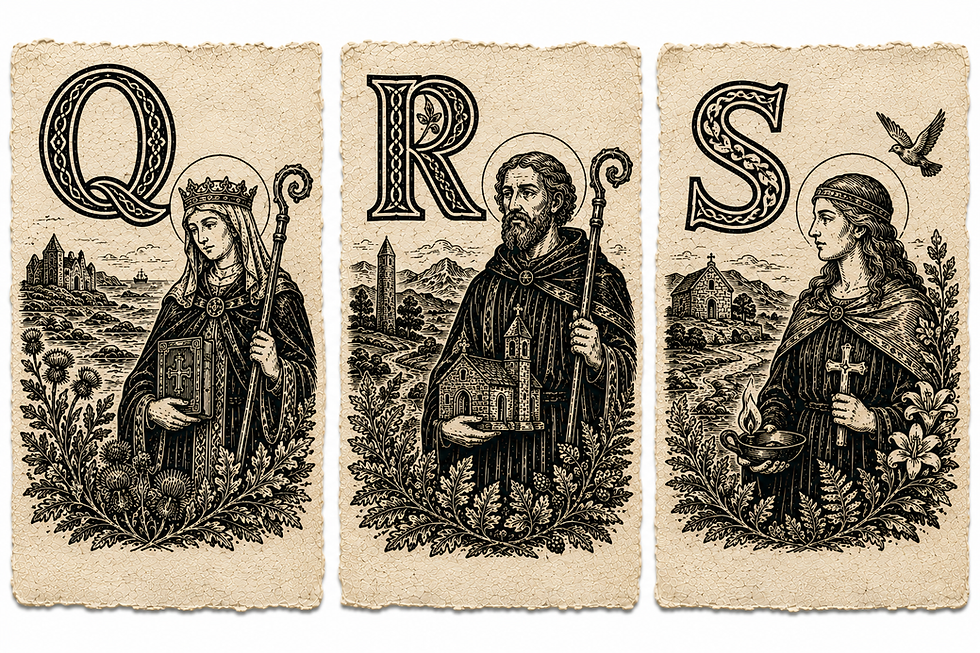
S is for Saint Samson of Dol
Saint Samson of Dol was a Welsh saint who became one of the great founder saints associated with Brittany. His life reflects the close links between Wales, Cornwall and Brittany in the early medieval Christian world.
Samson reminds us that Celtic Christianity was not confined to the British and Irish islands. Brittany is part of the same spiritual coastline: a place of migration, monastic foundations, Breton saints and enduring Christian memory.
T is for Saint Teneu
Saint Teneu, also known by forms such as Thenew or Enoch, is remembered as the mother of Saint Mungo. Her story is difficult, tender and powerful, bound up with vulnerability, survival and the beginnings of Glasgow’s Christian memory.
Teneu matters because saints are not only heroic missionaries and abbots. Some are remembered through suffering endured, children raised, danger survived and dignity preserved. Her place in the story gives a human depth to the holiness of Glasgow.
U is for Saint Uny, or Euny
Saint Uny, also called Euny, is one of the Cornish saints associated with the early Christian landscape of west Cornwall. His name survives in church dedications and local tradition.
Saints like Uny remind us that the Celtic Christian world is often hidden in place names. A church, a parish, a ruined chapel, a holy well or a local feast may preserve the memory of a saint long after the written story has faded.

V is for Vigeans, and Saint Féichín behind the name
V is another difficult letter. St Vigeans in Angus, Scotland, is a place name linked with the Irish saint Féichín. The village and its extraordinary carved stones belong to the wider story of early Christian and Pictish Scotland.
This is one of the loveliest things about Celtic saints: their names often survive in altered forms. A saint’s name may be softened, reshaped or half-hidden by centuries of speech, but the memory remains.
W is for Saint Winefride
Saint Winefride, or Gwenffrewi in Welsh, is associated with Holywell in north Wales, one of the most enduring pilgrimage places in Britain. Her story is dramatic, but the lasting devotion around her is centred on healing, prayer and pilgrimage.
Winefride reminds us that holy wells were not decorative extras in Celtic Christianity. They were places where landscape, water, memory and prayer met. People came with need, gratitude, illness, grief and hope.
X is for the Cross
There is no need to force a doubtful saint into X. Instead, X can stand for the cross, because the cross is everywhere in the Celtic Christian world: carved in stone, carried in processions, marked on wells, raised on islands, worn close to the heart.
The Celtic cross is not just an ornament. At its best, it is a sermon in stone: the cross of Christ standing in creation, encircled by eternity, weathered by wind and rain, but still upright.

Y is for Saint Yves of Kermartin
Saint Yves, or Ivo of Kermartin, is a later Breton saint and the patron saint of Brittany. He is also remembered as a patron of lawyers and the poor.
Although he belongs to a later period than many of the early island saints, Yves still has a rightful place in a wider Celtic saints alphabet. He shows that the Christian story of Brittany did not end with the early monastic age. It continued in parish life, justice, charity and service to the poor.
Z is for zeal
Z is another place where honesty is better than invention. Rather than pretending there is an obvious famous Celtic saint for every English letter, Z can stand for zeal: the burning love of God that carried these saints across seas, into monasteries, through exile, into teaching, healing, writing, preaching and prayer.
That zeal is the golden thread. It links Brigid’s hearth, Columba’s Iona, David’s little things, Gobnait’s bees, Mungo’s Glasgow and Patrick’s return to Ireland.
Why Celtic saints still speak to us
The Celtic saints endure because they feel close to the texture of ordinary life. They are tied to shorelines, wells, bees, books, bells, islands, sheep tracks, ferries, burial grounds, oak trees, stone crosses and small chapels.
They remind us that holiness is not abstract. It happens somewhere. It is prayed into a landscape, carried by a community, remembered in a name, and passed from one generation to another.
For many people today, Celtic saints offer a way of praying that feels rooted and human: less polished, more weathered; less grand, more faithful. They speak to pilgrims, converts, mourners, makers, gardeners, readers, wanderers and those beginning again.
Paisley Honey is a Scottish handmade devotional gift business based in Paisley, with 32,000+ orders fulfilled across platforms and thousands of five-star reviews from customers around the world. You can read more about why customers trust Paisley Honey.
Our handmade rosaries, Anglican prayer beads, Celtic cross designs and Iona-inspired devotional gifts are made for people who want prayer beads with meaning: not mass-produced religious objects, but small companions for prayer, remembrance, pilgrimage and faith.

Questions people often ask about Celtic saints
Who are the main Celtic saints?
Some of the best-known Celtic saints include Saint Patrick, Saint Brigid, Saint Columba, Saint Aidan, Saint David, Saint Ninian, Saint Mungo, Saint Finbarr, Saint Gobnait, Saint Ita and Saint Samson of Dol. There are many more local saints remembered in Ireland, Scotland, Wales, Cornwall, Brittany and the Isle of Man.
What makes a saint a Celtic saint?
“Celtic saint” is a broad phrase rather than a precise official category. It usually refers to saints connected with the Celtic Christian cultures of Ireland, Scotland, Wales, Cornwall, Brittany and sometimes the Isle of Man, especially during the early medieval period.
Are Celtic saints Catholic?
Many Celtic saints lived long before the later divisions between Christian traditions. They are often venerated in Catholic, Orthodox and Anglican contexts. Their stories belong to the shared Christian heritage of the early Church in these islands and coastal regions.
Which Celtic saint is associated with bees?
Saint Gobnait is traditionally associated with bees and beekeeping. She is especially connected with Ballyvourney in County Cork and is remembered as a saint of healing, protection and honeybees.
Which saint is connected with Iona?
Saint Columba, also known as Colmcille, is the great saint connected with Iona. He founded the monastery there, and Iona became one of the most important spiritual centres in the early Christian story of Scotland and the north Atlantic world.
Which Celtic saint is linked with Glasgow?
Saint Mungo, also known as Saint Kentigern, is the patron saint of Glasgow. His symbols are still part of the city’s story: the bird, the tree, the bell and the fish with the ring.
Why are Celtic crosses associated with Celtic saints?
Celtic crosses are strongly associated with the Christian landscapes of Ireland, Scotland and other Celtic regions. They appear in stone carving, grave markers, pilgrimage sites and devotional art. The ringed cross has become one of the most recognisable symbols of Celtic Christian heritage.
Can I use a Celtic saint rosary as a gift?
Yes. A rosary or prayer bead set inspired by a Celtic saint can make a meaningful gift for Confirmation, Baptism, First Communion, RCIA, pilgrimage, grief, recovery, birthdays or simply as a sign of encouragement. The saint adds a layer of story and prayer to the gift. We have written a short guide to selecting the perfect rosary gift here.


Comments