


Before the Feast: Preparing for the Transitus of Saint Francis, Eight Hundred Years On

Updated: Aug 13
Most of us meet Saint Francis in daylight. He stands in gardens with a bird upon his hand. His feast is marked with animals, flowers and the goodness of the created world. These are not false pictures of Francis. But they are not the whole of him.

One of the most intimate Franciscan remembrances begins in the evening. On 3 October, as daylight fades, communities gather for the Transitus: the passage of Francis from this life into eternal life with God. Here in Scotland, where the evenings are already drawing in by early October, the date has a physical shape of its own—the light thinning, the day’s work being laid down and a lamp lit against the dark.
This year that quiet observance carries particular weight. On the evening of 3 October 2026, it will be eight hundred years since Francis died at the Portiuncula in the valley below Assisi.
Transitus means passage or crossing. It does not pretend that death is painless, nor ask us to hurry past grief towards a reassuring conclusion. It names death truthfully while refusing to treat it as the end of the story. Francis, who could call even bodily death his sister, met that final crossing as he had tried to meet the rest of creation: not as something he possessed or controlled, but as something held within the goodness of God.
The evening before the feast
The feast of Saint Francis falls on 4 October. The evening before it is less widely known outside Franciscan communities, but Franciscans have long gathered then to remember his final hours. The form of the service varies. It may include Scripture, prayer, the Canticle of the Creatures and accounts preserved by Francis’s early companions and biographers.

By October 1226, Francis was gravely ill and almost blind. He asked to be taken from the bishop’s residence in Assisi down to the Portiuncula, the place where his early brotherhood had taken shape. There, dependent upon the care of others and surrounded by companions, he blessed them and prepared to die.
The details remembered from those final hours are strikingly simple. There was Scripture, prayer, the earth beneath him and the presence of the brothers who had shared his life. Francis asked for the Gospel of John to be read from the passage beginning, “Before the Feast of Passover” (John 13:1). Today, John 13:1–17, in which Jesus washes his disciples’ feet, is commonly read during the Transitus.
It is a fitting passage. At the end of his life, Francis’s attention was directed not towards achievement or reputation, but towards Christ kneeling to serve his friends. The image is not of power gathered and defended. It is of love made visible in humility.
It also matters that Francis was not alone. The Transitus does not present a solitary spiritual hero mastering death by force of will. We meet a frail man among his companions, receiving their care and unable to carry anything further for himself. His life was being handed back.

Why an eighth centenary matters
The special Year of Saint Francis runs from 10 January 2026 until 10 January 2027. It completes a remarkable sequence of Franciscan centenaries: the approval of the Later Rule and Christmas at Greccio in 2023, the Stigmata in 2024, the Canticle of the Creatures in 2025, and now the Transitus in 2026, often described in Franciscan sources as the “Easter of Francis”: his passage through death into eternal life.
An anniversary can become little more than a date polished for display. The better use of it is as a place from which to look again.
Eight hundred years have passed, but the disorders against which Francis’s life protests have not disappeared: our hunger to possess, our habit of dividing the world into those who matter and those who do not, our estrangement from the created life upon which we depend, and the ease with which fear hardens into hostility.
This is why peace stands at the heart of the official centenary message. In his letter for the anniversary, Pope Leo XIV remembers Francis approaching death as a man at peace and asks that we become “unarmed and disarming witnesses” in a world marked by conflict and division.
This is not a passive peace or a preference for avoiding difficult things. Franciscan peace is something received from God and then practised: in mercy, reconciliation, humility, restraint and the patient rebuilding of relationship. It begins within us, but it cannot remain there.
The centenary is therefore not principally an invitation to admire Francis from a greater distance. It asks where his life still unsettles ours.
Preparing quietly
There is no need to manufacture a grand observance. Preparation may begin simply by reading more slowly.
Many people know the bright opening movement of the Canticle of the Creatures: Brother Sun, Sister Moon, wind, water, fire and Mother Earth. Fewer reach its final movement, where Francis speaks of forgiveness, suffering and the bodily death from which no living person can escape. He does not praise pain for its own sake. Rather, he places even the parts of creaturely life we cannot master within his praise of God. His hope is not casual optimism: the same stanza warns of mortal sin and blesses those whom death finds within God’s will.
Reading the final stanzas of the Canticle beside John 13 would be one gentle way to approach the anniversary. Both turn our attention away from mastery. One places death within the family of creation; the other places Christ before us with a towel around his waist, washing feet.
Preparation might also begin not with acquiring anything, but with repairing something. There may be a message that has been postponed, an apology that has become more difficult through delay, or a grievance we have rehearsed so often that it now feels like part of us. Not every broken relationship can safely or honestly be restored.
Reconciliation does not require returning to harm. But most of us know at least one place where pride could loosen its hold, where we could speak more gently or where we might stop feeding a conflict.
Mercy can become practical too. The Franciscan Family’s centenary letter, A Seed for Eternal Life, returns to the encounters that changed Francis: his meeting with people affected by leprosy and his encounter with the Crucified Christ. His conversion was not merely a decision to own less. It was a transformed way of seeing and approaching those whom he had previously kept at a distance.
A fitting act for this year need not be dramatic. It might be care given where it will not be noticed, money quietly redirected, waste avoided, a burden shared, or time offered to someone who cannot repay it. Francis’s love of creation was never merely decorative. Creatures were no longer scenery, and people in poverty or sickness were no longer interruptions.
Some may choose to make a small pilgrimage before October: to a Franciscan church, friary or place associated with Saint Francis. A pilgrimage need not involve a flight to Assisi. It can be a local journey made deliberately, with time allowed for silence and prayer. Catholic readers wishing to learn about the Jubilee indulgence and its conditions can find the details in the official decree.
On the evening of 3 October, some will attend a Transitus service. Others might mark the anniversary at home with a candle, a simple cross, John 13:1–17 and a period of silence. We might name before God the people and places most in need of peace, pray the Lord’s Prayer and ask what in our own lives needs to be released—and what still asks to be loved.
Those unfamiliar with formal prayer need not manufacture the right words. Honest attention may be enough with which to begin.
A life not neatly completed
There is comfort in remembering that Francis did not reach the end with every problem solved. The community around him had grown far beyond the small brotherhood with which he began. Its future was no longer his alone to direct, and the fraternity’s rapid growth had brought questions that would outlast him.
The Transitus does not present us with a man who completed life perfectly and tied up every loose end. It presents a man who reached the point at which the unfinished work had to pass into other hands—and into God’s.
Most lives contain something unfinished: work we cannot complete, people we cannot protect from every sorrow, questions that remain unanswered and outcomes that will not yield to effort. Francis does not make those limits easy. He does suggest that they need not make love or faithfulness meaningless.
Perhaps this is one reason the Transitus speaks so quietly but so powerfully. It is not a celebration of giving up. It is the recognition that surrender can come after faithfulness: after the work that was ours to do, the mercy that was ours to offer and the peace that was ours to seek.
A small maker’s response
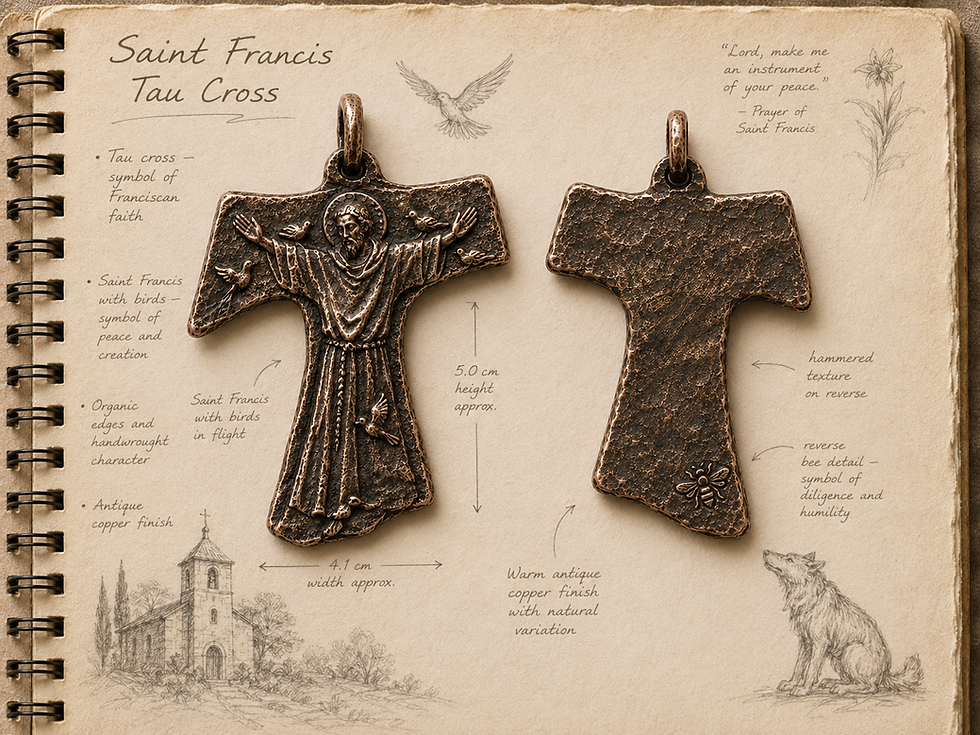
The Tau cross—the simple sign so closely associated with Francis—has also been finding its way onto my workbench this year. I am preparing a small collection of Tau-cross prayer beads and pendants, specially made during the eighth centenary year of the Transitus of Saint Francis, 1226–2026. I will share them when the work and photographs are ready; for now, it seems right simply to mark why this year matters.
On and around 4 October, many communities will mark the feast with songs, animal blessings and familiar stories of Francis among the creatures. There is goodness in all of these. But first comes the evening.
Perhaps that order is itself part of the gift: before celebration, remembrance; before the beloved image of Francis in the sunlight, the frail man lying among his brothers; before the feast, a life returned to God.
Eight hundred years later, we are not being asked to reproduce the life of Francis. We might simply allow his passing to ask what in our own lives could still be reconciled, simplified or shared—and what, after all the faithful work we can do, must finally be entrusted.
May the Lord give you peace.


Comments