


The Simplest Cross: Why Saint Francis Made the Tau His Sign

Updated: Sep 17
Most crosses I work with invite detail: a figure, a border, lettering, perhaps a medal or a story held in relief. The Tau asks me to stop.
It can be made in two strokes—one descending and one across. It can be cut into wood, pressed into leather, cast in metal or marked on paper. It needs no elaborate border, ornament or precious material. It is the cross brought close to its simplest shape.

That simplicity changes the question. The Tau is often explained as “the Franciscan cross”, as though Francis selected a useful emblem and his followers adopted it. Yet Francis did not invent the sign, and he used it as something more demanding than a badge. It came to him already carrying an ancient biblical memory of grief, mercy and conversion. He drew it in blessing and placed it where another person might have written a name.
As a maker, I find that difference arresting. A maker’s mark ordinarily says, “I made this.” Francis’s mark seems to say something closer to, “Let this life be turned towards Christ.” It does not hold attention upon its maker. It points beyond him.
Perhaps that is why the simplest cross became his sign.
A letter before it was a cross
The word Tau is the name of the nineteenth letter of the Greek alphabet. In its capital form it is written T. The biblical root of the symbol is connected with the Hebrew taw or tav, the final letter of the Hebrew alphabet and also a word for a mark or sign.
In the ninth chapter of Ezekiel, a mark is placed on the foreheads of those who grieve over the wrongdoing taking place in Jerusalem. In forms of the ancient Hebrew script, taw could be written as a cross-shaped mark. Christian readers came to see in that sign a foreshadowing of the cross of Christ: a mark associated with repentance, faithfulness and the mercy of God.
The people marked in Ezekiel are not distinguished by power, rank or a claim to their own purity. They are those who have not become indifferent to the wrong around them. The biblical background therefore gives the Tau a moral weight easily lost when it becomes merely decorative. It begins with the ability to grieve, and it calls for a changed life.
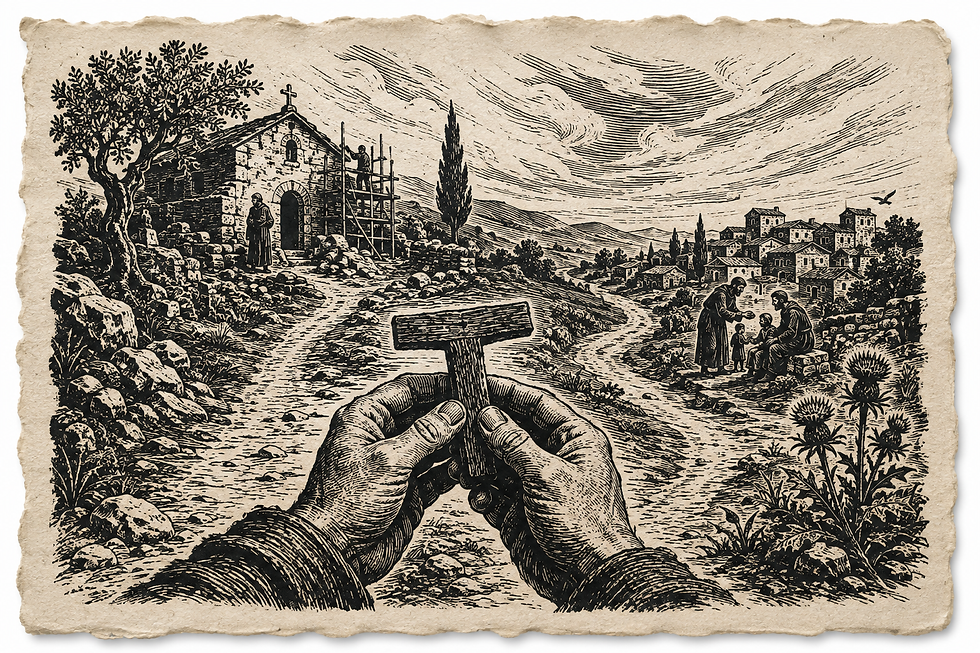
The T-shaped cross was therefore not new in Francis’s lifetime. It had appeared in Christian thought and art long before him and was also associated with Saint Anthony of Egypt. But a particular moment in 1215 helps explain why it became so important within the Franciscan story.
At the opening of the Fourth Lateran Council, Pope Innocent III preached from Ezekiel’s image of the mark. He used the Tau as a call to reform: a sign for those willing to turn again towards God and take part in the renewal of the Church. In this context, penance did not mean religious gloom or punishment for its own sake. It meant conversion—a life continually being turned back towards God.
Later tradition places Francis at the council, but contemporary sources do not confirm that he heard the sermon in person. The Tau nevertheless belonged to the Church’s wider language of reform in which his movement developed, and it became one of his most characteristic signs. We know much more confidently what the Tau came to mean to Francis than the precise day or encounter by which it became his sign.
The uncertainty does not weaken the connection. It saves us from turning a spiritual history into a tidier story than the evidence permits.
The mark in Francis’s own hand
Francis’s attachment to the Tau is not known only through later paintings or devotional tradition. His early biographers describe his preference for it, and we still have an extraordinary physical witness: a small piece of parchment made for Brother Leo, one of his closest companions.
At La Verna in 1224, Francis wrote the Praises of God on one side of a small parchment and a personal blessing for Leo on the other. The blessing draws upon the priestly words of Numbers 6, asking that God bless, keep and grant peace. Francis also drew a large Tau in his own hand, and Leo annotated the parchment to identify the writing as Francis’s. This Chartula is one of only two surviving documents in Francis’s own hand and is preserved at the Basilica of Saint Francis in Assisi.
This may be the most revealing way to encounter the symbol. The Tau does not appear there as an abstract emblem. It belongs to a relationship.
Brother Leo was troubled and in need of reassurance. Francis responded with words written for him, a blessing and a simple mark. The parchment is theological, but it is also personal: one human being trying to strengthen another. The Tau stands beside praise, friendship and peace.
Early accounts also remember Francis using the sign in place of a signature and marking it on the walls of places where the brothers lived. It became a repeated gesture—something made by the hand as well as carried in the heart.

Why this cross suited Francis
It is tempting to explain the Tau simply by saying that Francis loved nature, poverty and simplicity. All of that matters, but it does not reach the centre of the sign.
The Tau points first towards Christ.
Francis’s life was shaped by his encounter with the Crucified Christ at San Damiano, by his desire to follow the Gospel closely and, near the end of his life, by receiving the Stigmata. His simplicity was not an aesthetic preference for rustic things. It was an attempt to remove whatever stood between him and the life of Christ.
For Francis, conversion was not a single dramatic event completed in youth. It was a continuing reorientation: away from status and possession, towards mercy; away from the life of the aspiring knight, towards the life of a lesser brother; away from keeping suffering at a distance, towards meeting Christ among people he had once feared.
The Tau could hold all of this without becoming complicated. It recalled the cross. It carried Ezekiel’s call to turn away from wrongdoing. It marked a willingness to begin again.
Its shape is sometimes described as incomplete because it lacks the upper arm seen on many Western crosses. Historically, that is simply the form of the letter. Yet to a maker—and perhaps to anyone trying to live a life of faith—its open, elemental appearance can feel appropriate. Christian conversion is not a finished possession. The work of becoming more truthful, merciful and peaceful is never neatly completed.
The Tau does not offer a polished image of arrival. It looks more like a beginning.
What the Tau does not mean
Religious signs can become so familiar that we stop asking what they mean. They can also acquire meanings they were never intended to carry.
The Tau is not a charm. Ezekiel’s mark is associated with preservation, but a Christian cross is not a magical guarantee against suffering. It points beyond itself towards God; it does not give us control over God or over what will happen to us.
Nor is the Tau simply a nature symbol. Francis’s kinship with creation is real and essential, but the Tau belongs to his explicitly Christian response to the Gospel and the Crucified Christ. To detach it completely from that centre is to make the sign easier, but also smaller.
It is not proof that the person wearing it is a friar, sister or professed Secular Franciscan. Within parts of the Franciscan family, receiving or wearing a particular Tau may have a formal place and should be treated respectfully. The cross itself, however, is not private property. It may be worn by anyone who wishes to carry a Christian cross and to remember the example of Francis.
Most importantly, wearing a Tau does not by itself make a life Franciscan. A symbol can express a commitment, remind us of it and call us back when we forget. It cannot live that commitment on our behalf.
Carrying a small question
A Tau worn around the neck or held at the end of prayer beads can become a quiet interruption in the day. Its value may lie less in announcing something to other people than in asking something of the person who carries it.
What needs to be repaired?
Where am I protecting status, comfort or possession at another person’s expense?
Whom have I found easier to keep at a distance?
What would it mean to carry peace into this particular conversation, home or place of work?
These are not questions that must be answered perfectly before someone may wear the sign. They are reasons to keep returning to it.
The Tau can also anchor a very simple prayer. Hold it for a moment. Remember the blessing Francis gave to Leo. Ask for the grace to bless rather than diminish, to repair rather than discard, and to carry peace into the next thing that must be done.
The Tau on my workbench
The simplicity of this sign is why I wanted the new Saint Francis collection to be centred upon it. This is the most rustic range I have made: maple with bronze, jade with antiqued brass, Catholic rosaries, Anglican prayer beads, a Franciscan crown and a Tau worn simply on leather.
The materials are not intended to disguise their nature. Wood carries grain. Stone varies from bead to bead. Antiqued metal has shadow and depth, while leather softens through handling. The pieces are made to be held and used in prayer rather than kept untouched and immaculate.
These are not official Jubilee objects, nor an attempt to contain the legacy of Francis in something that can be owned. They are a maker’s response to an extraordinary anniversary: practical devotional pieces, specially made during the eighth centenary year of the Transitus of Saint Francis, 1226–2026.
When Francis placed a Tau on the blessing for Brother Leo, he left us more than a recognisable emblem. He showed the sign at work: drawn by one hand for another person, accompanying words of care and peace.
That may still be the best way to understand it. The meaning of the Tau is not exhausted by its history, its material or the identity of the person wearing it. Its meaning has to move from the object into life.
Eight centuries after Francis’s death, the Tau still refuses to make Francis the destination. Even when it appears within a richly detailed devotional object, its plain shape points beyond him to the Cross that formed his life.
The Tau may be one of the easiest crosses in the world to draw. What it asks of a life is much harder. It asks us to look again at Christ—and then at the life we are living.
May the Lord give you peace.


Really enjoyed reading this. Illuminating. Thanks!