


Teresa of Ávila and Quiet Prayer: Learning to Pay Attention

Saint Teresa of Ávila, remembered on 15 October, understood prayer as a relationship with God. You do not need an impressive vocabulary, a perfectly quiet mind or a life removed from ordinary responsibilities to begin. A few minutes of honest attention can be a beginning.
That is an inviting thought in a world where attention is pulled in so many directions. At Paisley Honey, making prayer beads and engraving devotional designs involves looking closely at small things. A join must sit properly; a line must remain legible; the shape of a cross needs room to be seen. These are practical requirements of making, but they also offer a useful starting point for thinking about attention.
Prayer asks for a different kind of attention: turning towards someone, rather than completing something. Teresa helps us make that distinction.

Who was Teresa of Ávila?
Teresa was a Spanish Carmelite nun, writer and reformer who lived from 1515 to 1582. She is also known as Teresa of Jesus. Her books include The Life, The Way of Perfection and The Interior Castle, which explores the soul’s journey towards God through the image of a castle with many dwelling places.
She helped establish the reform that became the Discalced Carmelite tradition, working alongside John of the Cross. In 1970, she was declared a Doctor of the Church: recognition of the enduring significance of her teaching.
There is something reassuring about encountering a teacher of prayer whose life also involved organising, travelling, writing and negotiating. Teresa’s contemplative life existed alongside demanding work. Her example opens a conversation about prayer within a full life, as well as prayer in solitude.
Benedict XVI’s introduction to Teresa offers a useful starting point for her biography and writings.
Teresa is also one of the teachers explored in Five Mystic Saints and What They Teach Us About Prayer. That broader reflection sets her teaching alongside John of the Cross, Hildegard of Bingen, Faustina Kowalska and Catherine of Siena. Here, we stay with Teresa’s understanding of friendship with God and consider one small way to begin.
Prayer as friendship
The Catechism draws on Teresa’s understanding of inner prayer as spending time with the God who loves us. The centre of the practice is a relationship with Christ. We bring our attention, our difficulties and our desire to be present; the encounter is not something we manufacture.
That matters when we imagine prayer as a test of concentration. Friendship is not measured by how many polished sentences we produce. There are times for speaking and times for listening. There are also days when simply arriving is the most honest thing we can do.
Teresa’s language offers a way into prayer for people who feel they have lost the habit, or who have never known quite how to start. Begin with the desire to turn towards God. You can learn words and practices gradually.
Read the Catechism’s explanation of contemplative prayer for the fuller Catholic teaching.
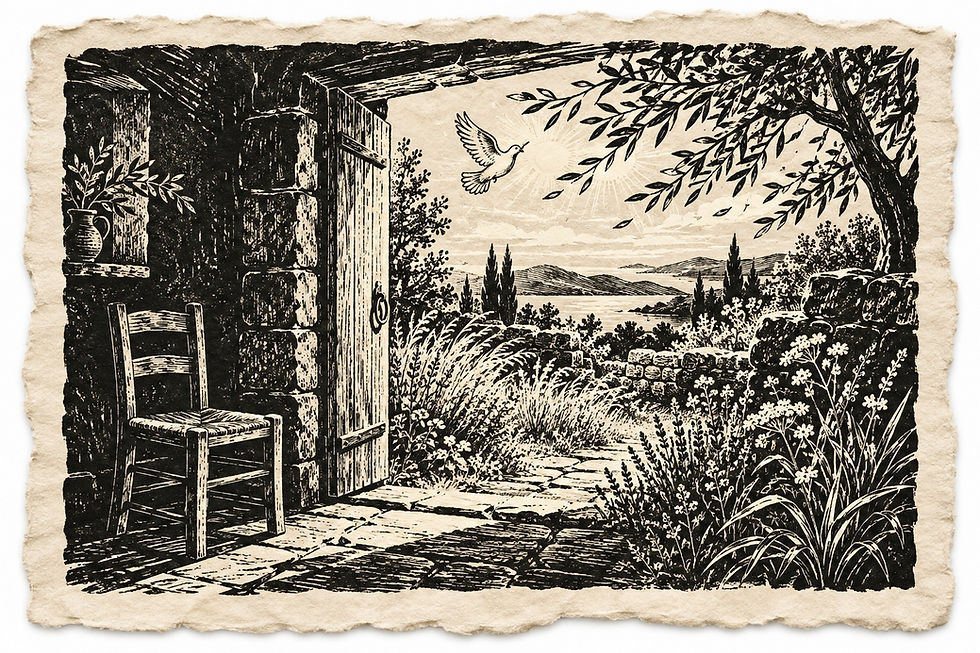
A simple five-minute quiet-prayer practice
The following is a suggested beginner’s exercise inspired by that understanding of prayer. It is not a formula prescribed by Teresa, or a technique for producing mystical experiences.
1. Give these minutes a place
Sit somewhere reasonably comfortable. Put your phone aside if you can. Choose a time that is realistic: before the day begins, after a walk, or when the house has settled in the evening.
You do not need to create a special room. An ordinary chair can become the place where you return to prayer.
2. Turn towards Christ
Make the sign of the cross if that belongs to your practice. Say a few plain words, such as: “Jesus, I am here. Help me to be present to you.”
Let those words be enough for the moment. There is no need to explain your whole life before prayer can begin.
3. Bring one thing honestly
Name something that is occupying you: gratitude, a worry, someone you love, or a difficulty you do not understand. Address God directly in your own words.
You may find it helpful to read a short Gospel passage first. Choose a few verses rather than a large reading that leaves you feeling you must finish a task.
4. Leave a little silence
Stay for a short time without adding more words. If your attention wanders, notice it and turn gently back towards Christ. You can repeat your opening sentence.
Silence can feel ordinary, awkward or uneventful. Those feelings need not decide whether you return tomorrow.
5. Finish simply
End with the Our Father, or a short expression of thanks. Carry one small intention into the next part of your day: listen more carefully, speak kindly, or attend to someone who needs you.
The exercise gives prayer a beginning and an ending without requiring you to assess whether you have done it well.
When your mind will not stay still
A distracting thought may be a shopping list, a work deadline or a conversation that still troubles you. Sometimes it helps to jot down a practical reminder before prayer, so you do not keep rehearsing it.
If the thought concerns something painful, you can bring it into the prayer itself. There is no need to hide the thing that most needs God’s care behind a performance of serenity.
Our reflection on beginning again when prayer is difficult explores the value of returning without demanding perfection.
What can a rosary or a saint’s image offer?
The rosary combines spoken prayers with contemplation of the mysteries of Christ’s life. Its beads can give the hands a familiar rhythm that supports attention. The short exercise above uses personal words and silence rather than the rosary’s sequence of prayers, but the two can sit alongside one another: a decade may lead naturally into a quiet pause with Christ.
A saint’s image can also serve as a reminder of a person whose teaching you want to remember. Our Teresa of Ávila engraved rosary pouch places that reminder on an everyday object used to keep prayer beads together.
The object serves the practice. No particular pouch or set of beads is necessary to spend time with God. For those who find touch helpful, we have also written about why the feel of a rosary matters in prayer.

A small beginning, made in ordinary life
A maker learns to return to the thing immediately in front of them. Prayer invites a return too, although its purpose reaches beyond the workbench and its measures of success. Teresa’s feast is an opportunity to give that return a little time.
Begin with five minutes. Arrive honestly. Let tomorrow offer another beginning.
Paisley Honey is a Scottish handmade devotional gift business based in Paisley, with 32,000+ orders fulfilled across platforms and thousands of five-star reviews from customers around the world. Read why customers trust Paisley Honey for more about our work and customer care.
Questions about Teresa and quiet prayer
Is Teresa of Ávila the same saint as Thérèse of Lisieux?
No. Teresa of Ávila was the sixteenth-century Spanish Carmelite reformer. Thérèse of Lisieux was a nineteenth-century French Carmelite associated with the “little way”. Both are Doctors of the Church.
Do I need prayer beads for this exercise?
No. You can pray with empty hands. Beads or a devotional image may help you remember to begin, but the relationship with God is the centre of the practice.
Is this the same as praying the rosary?
This exercise offers a short period of personal prayer and silence, rather than the rosary’s sequence of prayers and mysteries. The rosary itself is a contemplative prayer, and you may use both forms in your prayer life.
When is Teresa of Ávila’s feast day?
Her Catholic memorial is 15 October. That date can be a prompt to read a little of her teaching and begin a modest prayer habit.


Comments