


An Amen of Prayers: A Poetic A–Z of Collective Nouns for Faith

We have wonderful names for gatherings in the natural world: a murmuration of starlings, a parliament of owls, a charm of goldfinches. These words describe more than number. They tell us something about the character of the gathering—its movement, sound or mystery.
Faith gathers things too. It gathers voices into worship, beads into rosaries, strangers into fellowship and private sorrows into shared prayer. What, then, might we call these gatherings?

Some of the expressions below belong to longstanding Christian tradition. Others are newly coined, offered in the same playful and poetic spirit as the old collective nouns. This is not a lost religious dictionary, but an invitation to notice the many ways in which prayer brings separate things together.
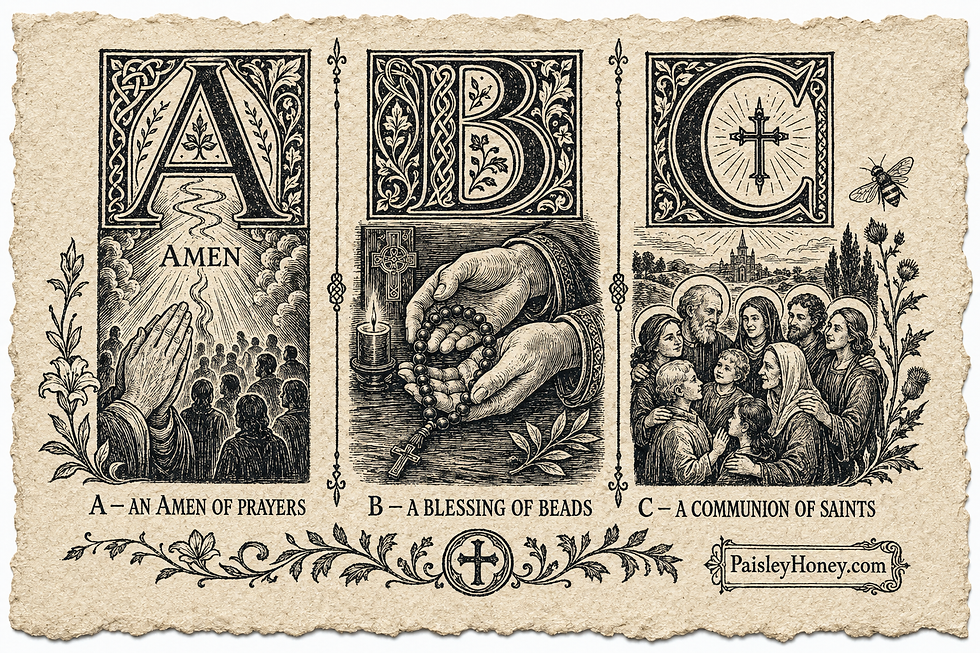
A — An Amen of Prayers
A prayer may begin in uncertainty, longing or grief, but it eventually reaches its Amen.
Amen does not simply mean that the prayer is finished. It carries the sense of affirmation: let it be so; I place this in God’s hands. When many prayers are gathered together—spoken aloud, whispered privately or carried silently within us—they become an Amen of prayers.
B — A Blessing of Beads
Prayer often travels from the lips into the hands.
Beads become polished through years of being held. They pass through fingers beside hospital beds, on long journeys, in quiet churches and during wakeful nights. Individually, they are small and ordinary things. Gathered together and given purpose, they become a blessing of beads: a path the hands can follow when the mind struggles to find the next word.
C — A Communion of Saints
This is not an invented expression, but one of the oldest and most beautiful collective ideas in Christianity.
The communion of saints reaches beyond place and time. It gathers the faithful living and departed, the famous and forgotten, the canonised saint and the quiet believer whose name may never appear in a book. Faith is never entirely solitary. Every prayer joins a communion already in progress.
D — A Decade of Hail Marys
A decade is a gathering of ten prayers, but it is also a small chamber within the greater architecture of the Rosary.
Each Hail Mary follows the one before it, allowing the restless mind to settle into rhythm. Together they create space in which one of the mysteries of Christ’s life can be contemplated. A decade is not needless repetition. It is prayer given enough time to deepen.
E — An Epiphany of Seekers
An epiphany is a moment of recognition: a light appearing, a truth becoming visible, or something long suspected finally being understood.
An epiphany of seekers might gather all those who have not yet arrived at certainty but continue to follow the light they have been given. Faith does not always begin with answers. Sometimes it begins with the courage to keep looking.
F — A Fellowship of the Faithful
Fellowship is faith made companionable.
It is found in a congregation singing together, in neighbours carrying food to a grieving family, and in the person who quietly says, “I will pray for you.” A fellowship of the faithful does not require everyone to be identical. It is held together by a shared willingness to walk alongside one another.

G — A Gloria of Voices
One voice can sing praise, but many voices create a Gloria.
Some will be strong and certain; others hesitant, weathered or slightly out of tune. Yet communal worship does not require perfection. A Gloria of voices is beautiful because each person lends what they have, allowing individual praise to become something larger than any single singer.
H — A Host of Angels
A host of angels appears throughout Christian scripture and tradition.
The word host suggests an innumerable company: messengers, guardians and servants of God gathered beyond ordinary sight. In paintings they may appear with wings and golden haloes, but their true significance lies in what they do. They announce, guide, protect and direct attention away from themselves and towards God.
I — An Incense of Prayers
Scripture repeatedly imagines prayer rising like incense.
Smoke cannot be held. It curls upwards, passing beyond our reach while leaving its fragrance behind. An incense of prayers contains petitions offered across generations: prayers of gratitude, lament, repentance and hope. We may not see where they go, but their offering changes the atmosphere around us.

J — A Jubilee of Bells
Church bells have long marked the sacred moments of ordinary life.
They announce weddings and funerals, feast days and Sunday worship. They call across rooftops, fields and crowded streets, reaching people who may never enter the church itself. When bells sound together, they become a jubilee—a gathering of bronze voices proclaiming that this moment should not pass unnoticed.
K — A Kyrie of Voices
Kyrie eleison: Lord, have mercy.
It is one of Christianity’s shortest prayers and one of its most enduring. When spoken by many voices, it becomes a Kyrie of humility. Each person arrives carrying different failings and sorrows, yet all meet within the same need for mercy.

L — A Litany of Saints
A litany gathers names into prayer.
One saint follows another: apostles, martyrs, teachers, healers, mystics and ordinary people who lived with extraordinary faithfulness. Their names form a procession through history. A litany of saints reminds us that holiness does not have a single face, personality or path.
M — A Mystery of Beads
A rosary is not merely a sequence of prayers. It is a way of entering the mysteries of Christ’s life.
The beads help us remain with moments that cannot be exhausted by a single reading: birth and loss, suffering and joy, death and resurrection. A mystery of beads gives the wandering mind somewhere to return. Each bead becomes a small doorway back into contemplation.
N — A Novena of Intentions
A novena gathers prayer across nine days.
It asks us to remain with an intention rather than offering it once and immediately moving on. The circumstances may not change during those nine days, but the person praying often does. A novena of intentions teaches the patient, sometimes difficult faith of returning tomorrow.

O — An Offering of Candles
A candle makes an invisible intention visible.
One flame may represent a person who is ill, someone who has died, a prayer for peace or a quiet word of thanksgiving. When many are lit together, they become an offering of candles. Each flame remains distinct, yet together they create a light no single candle could produce alone.
P — A Procession of Pilgrims
Pilgrims rarely travel only through geography.
The road passes through tiredness, discomfort, hospitality, uncertainty and unexpected kindness. A procession of pilgrims gathers people who may have begun for very different reasons but now share the same path. Their common destination slowly teaches them how to walk together.
Q — A Quiet of Contemplatives
Silence is not the absence of prayer. Sometimes it is prayer stripped of everything unnecessary.
A quiet of contemplatives might gather those who sit without demanding an answer, allowing themselves simply to remain in the presence of God. Their stillness is not empty. Like deep soil in winter, it holds life that has not yet become visible.

R — A Rosary of Remembrances
Prayer beads often come to carry particular names and memories.
One bead may recall a parent, another a friend, another a private sorrow known only to the person praying. Over time, the Rosary becomes a rosary of remembrances—a place where love, grief, gratitude and hope can be held without needing to be separated.
S — A Sanctuary of Souls
A sanctuary is usually imagined as a physical place, but people can also become a place of refuge for one another.
A sanctuary of souls is formed whenever the frightened are welcomed, the grieving are allowed to speak and the lonely discover that someone has noticed them. Its walls are compassion, its doorway is hospitality, and its light is the refusal to turn another person away.

T — A Thanksgiving of Hearts
Gratitude is not always loud.
Sometimes it is the sudden recognition of warmth after cold, food after hunger, friendship after loneliness or hope after despair. A thanksgiving of hearts gathers these quiet recognitions. It acknowledges that even within difficulty, there are gifts we did not create and could never have earned.
U — A Unity of Worshippers
Christian unity does not require uniformity.
A unity of worshippers may contain different traditions, cultures, languages and ways of praying. What binds them together is not complete agreement on every detail, but their shared turning towards God. Unity is not the disappearance of difference; it is difference held together by love.
V — A Vigil of Candles
A vigil is prayer that refuses to leave.
It keeps watch beside the sick, accompanies the dying, remembers the departed and waits through the darkness before a feast. A vigil of candles embodies this patient presence. The flames are small, but they remain—a quiet declaration that darkness will not have the final word.

W — A Witness of Martyrs
The word martyr is rooted in the idea of witness.
The martyrs are not gathered merely by the manner of their deaths, but by the truths to which their lives testified. A witness of martyrs reminds us that faith can require courage, and that love sometimes asks a person to stand firm when retreat would be easier.
X — A Xenia of Strangers
Xenia is an ancient Greek word for hospitality offered to the stranger or guest.
Within Christian life, welcoming the stranger is never a minor courtesy. It is one of the ways in which faith becomes visible. A xenia of strangers gathers people who arrived unknown to one another but were received with food, shelter and dignity. Through hospitality, strangers become guests—and guests may become friends.

Y — A Yearning of Souls
Some prayers begin before language.
They are felt as restlessness, homesickness, longing or the sense that something essential remains just beyond our grasp. A yearning of souls gathers all those wordless prayers. Even when we cannot name what we seek, the yearning itself may already be turning us towards God.
Z — A Zeal of Disciples
Zeal is faith set in motion.
It sends disciples out to serve, teach, heal, welcome and make peace. Yet true zeal is not harshness or noisy certainty. It is love made active and given direction. A zeal of disciples carries prayer beyond the sanctuary and into the places where mercy is most needed.
The Things That Prayer Gathers
From an Amen of prayers to a zeal of disciples, faith is continually gathering what might otherwise remain scattered.
It gathers beads beneath the fingers, names within a litany and candles in the darkness. It gathers saints across centuries, pilgrims upon the road and strangers around a shared table. It even gathers the fragments within ourselves—the hopeful and grieving, certain and questioning—and holds them together in prayer.
Perhaps this is why prayer beads have endured for so many generations. They make an unseen gathering tangible. A blessing of beads becomes a mystery, a remembrance, an intention and, eventually, an Amen.
Frequently Asked Questions
What is a collective noun for prayers?
There is no single established collective noun for prayers. In this poetic A–Z, we use an Amen of prayers to describe many spoken, whispered or silent prayers gathered together.
Are these recognised Christian expressions?
Some are traditional expressions, including a communion of saints, a host of angels and a decade of Hail Marys. Others are newly coined poetic phrases inspired by Christian worship and devotional life.
What is a collective noun for prayer beads?
We suggest a blessing of beads or a mystery of beads. Both reflect the way individual beads are gathered into a physical path for prayer and contemplation.
What does “a xenia of strangers” mean?
Xenia is an ancient Greek word describing hospitality offered to a stranger or guest. The phrase reflects the Christian tradition of welcoming strangers with food, shelter and dignity.
Why are candles associated with prayer?
Candles make an invisible prayer or intention visible. A flame may represent remembrance, thanksgiving, hope or prayer for someone in need.
Can I create my own collective nouns for faith and prayer?
Yes. This A–Z is intended as a poetic invitation rather than a formal religious dictionary. You might create new expressions inspired by worship, pilgrimage, scripture or your own experience of prayer.


Comments