


Padre Pio Feast Day: A Franciscan Life Held Together by Prayer

On 23 September, the Church celebrates the feast of Saint Pio of Pietrelcina, better known throughout the world as Padre Pio.
His is one of the most recognisable faces among modern Catholic saints: the bearded friar in a brown habit, his hands often hidden, his expression both serious and kind. Many people first encounter him through accounts of the extraordinary—the wounds he bore, the mystical experiences associated with him, and the crowds who travelled to San Giovanni Rotondo to attend his Mass or seek him out in confession.
Yet if we look only at the extraordinary, we may overlook the quieter truth at the centre of his life. Padre Pio described himself simply: “I am a poor Franciscan who prays.”
That small sentence may tell us more about him than any of the more dramatic stories.
Was Padre Pio a Franciscan?
Padre Pio was indeed a Franciscan. More precisely, he belonged to the Order of Friars Minor Capuchin, one of the communities within the wider Franciscan family. Born Francesco Forgione in southern Italy in 1887, he entered the Capuchin novitiate as a young man and received the religious name Pio.
The Capuchin tradition grew from a desire to live the Rule of Saint Francis with renewed simplicity: a life shaped by poverty, fraternity, prayer and closeness to ordinary people. For Padre Pio, this Franciscan identity was not merely the habit he wore or the initials placed after his name. It gave form to his whole life.
Saint Francis did not seek importance in the eyes of the world. He sought to become little enough for Christ to fill his life. Centuries later, Padre Pio followed that same downward path—not towards insignificance, but towards humility, dependence and service.
His life eventually attracted enormous attention, but fame was never meant to be its centre. Beneath everything visible was the hidden discipline of returning to God, hour after hour and day after day.
The hidden work of prayer
Padre Pio’s days were formed by the celebration of Mass, long hours in the confessional, correspondence, spiritual guidance and prayer. People came carrying illness, grief, guilt, uncertainty and hope. He could not alter every circumstance brought before him, but he could receive those burdens and carry them into prayer.
This is one of the most helpful ways to understand intercession. Prayer is not always the search for an immediate answer. Sometimes it is the decision not to turn away from another person’s suffering. We hold them before God when there is little else we can do, and we continue to hold them there when easy words have run out.
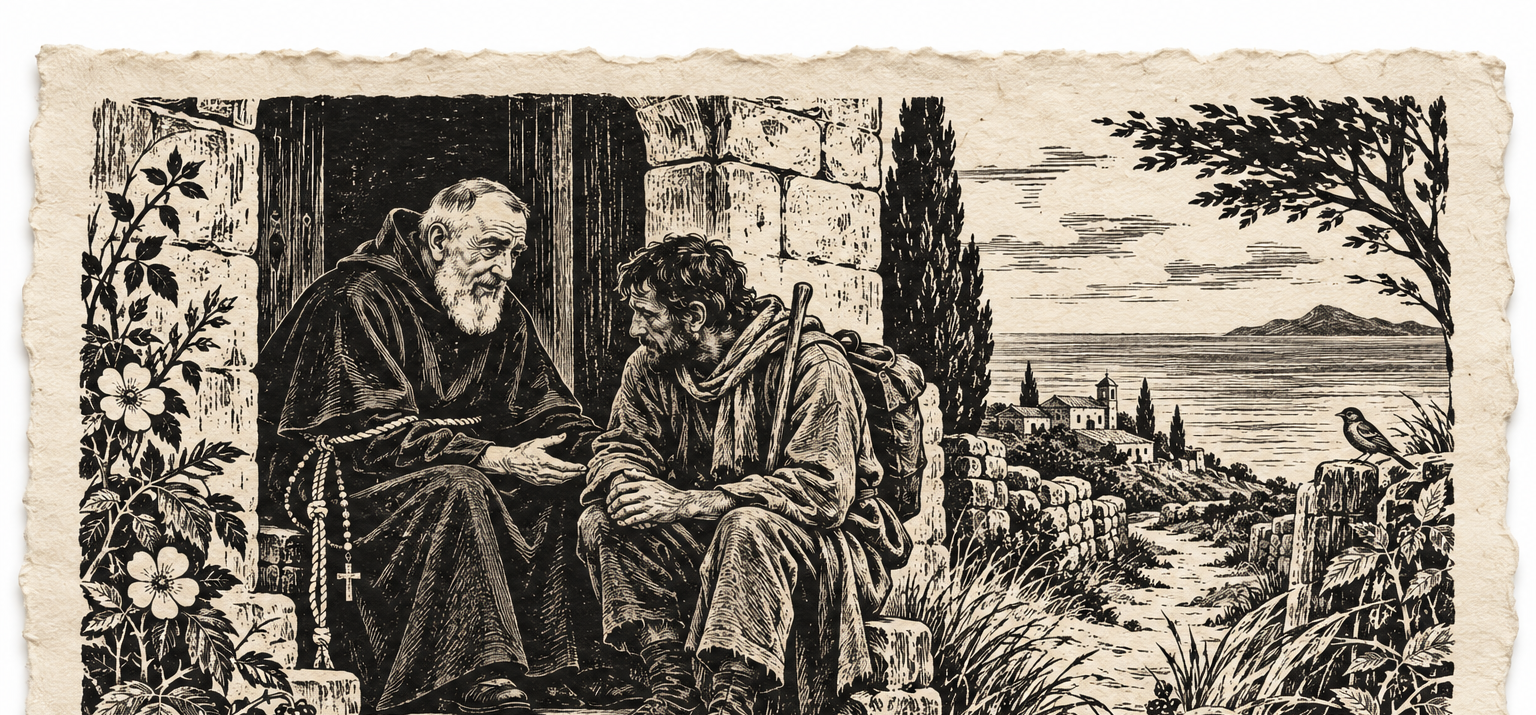
For Padre Pio, this interior life did not become an escape from practical care. His concern for the sick found lasting expression in the Casa Sollievo della Sofferenza—the Home for the Relief of Suffering—which opened in 1956. Prayer and action were not rivals in his life. Each gave truth to the other.
That, too, is deeply Franciscan. Love must become particular. It must eventually take the form of food, shelter, listening, forgiveness, medicine, companionship or some other work of mercy.
Padre Pio and the rosary
The rosary belonged within Padre Pio’s daily rhythm of prayer. In his hands it was not an ornament, nor an object reserved for moments when he felt especially devout. It was a way of returning—again and again—to the life of Christ in the company of Mary.
Prayer beads do something very humble. They do not pray on our behalf, and they do not require us to manufacture a particular feeling. They simply give prayer a shape. When the mind wanders, the fingers find the next bead. When words feel thin, the familiar prayers carry us. When life seems disordered, one prayer follows another.

A rosary is therefore not meant to remain perfect in a drawer. It is made to be carried: slipped into a pocket, held beside a hospital bed, taken on a journey, or reached for in the middle of an ordinary and difficult day. With use, the beads may soften and the metal may deepen in colour. These are not necessarily signs of damage. They can become the quiet record of a life in prayer.
Within the Franciscan tradition, the seven-decade Franciscan Crown offers another pattern of prayer, meditating upon the seven joys of Mary.
The holiness of showing up
Padre Pio’s life can seem far removed from our own. Most of us will never experience anything resembling the extraordinary events associated with him. His feast day does not ask us to imitate those things.
It asks a more searching question: will we return to prayer tomorrow?
Will we pray for the same person again, even when nothing appears to have changed? Will we make room for someone else’s pain without trying to explain it away? Will our prayers gradually become acts of patience, generosity and service?
There is a holiness in simply showing up: at prayer, beside someone who is suffering, or for the small duty that love has placed before us. Repetition can look unimpressive from the outside. Yet a life is often shaped by precisely these quiet acts of faithfulness.
Padre Pio became known throughout the world, but the foundation of his life remained remarkably simple: a Franciscan friar praying, serving and placing himself at the disposal of others.
Padre Pio feast day: an invitation to prayer
Celebrated shortly before the feast of Saint Francis on 4 October, Padre Pio’s feast offers an invitation into the Franciscan season.
That invitation carries particular meaning in 2026, as Franciscans and those inspired by them mark 800 years since the death of Saint Francis. Remembering Padre Pio within this anniversary year reminds us that the Franciscan story did not end at Assisi. It has continued through very different lives, places and centuries wherever people have chosen simplicity, prayer and loving service.
We might mark it by praying a decade of the rosary for someone whose burden we cannot remove. We might make one practical act of care that gives our prayer a body. Or we might simply begin again with the prayer practice we have neglected, without embarrassment and without waiting to feel ready.
The lesson of Padre Pio is not that faithful lives must be spectacular. It is that prayer, patiently returned to, can make a life available to God and to others.
Perhaps that is enough for any of us to begin: to become, in our own place and circumstances, a person who prays.
Saint Pio of Pietrelcina, teach us to pray faithfully, to carry one another with compassion, and to let our prayer become love in action.
At Paisley Honey, our handmade Saint Francis rosaries and devotional pieces are created in this same spirit of simplicity: made to be carried, prayed with and accompanied on the pilgrim path.
Questions people often ask about Padre Pio
When is Padre Pio’s feast day?
The Catholic Church celebrates Padre Pio’s feast day on 23 September, the anniversary of his death in 1968. It falls shortly before the feast of Saint Francis on 4 October, placing it naturally within a season of Franciscan prayer and remembrance.
What is Padre Pio best known for?
Padre Pio is often remembered for the stigmata and other extraordinary accounts associated with his life. Yet he was also known for celebrating Mass, hearing confessions, offering spiritual guidance, praying the rosary and caring for the sick.
Was Padre Pio a Capuchin or a Franciscan?
He was both. Padre Pio belonged to the Order of Friars Minor Capuchin, one of the principal branches of the wider Franciscan family. His brown habit, life of prayer and emphasis on humble service all belonged to that tradition.
Why is Padre Pio associated with the rosary?
The rosary was a constant part of Padre Pio’s prayer. He was frequently seen with rosary beads in his hands and encouraged others to return to the prayer faithfully, especially when they felt anxious, burdened or unable to find their own words.
What does “Pray, hope and don’t worry” mean?
The saying most closely associated with Padre Pio is not an invitation to deny fear or suffering. It is a call to place what we cannot control before God, remain hopeful, and continue doing the loving work that is still ours to do.
How can I mark Padre Pio’s feast day?
You might attend Mass, pray the rosary or a single decade for someone who is suffering, spend time in quiet prayer, or make one practical act of care. The simplest observance is often the most fitting: pray faithfully and let that prayer become service.


Comments